Why Pressure Washing Roof Warranty Claims Get Denied
Short answer: yes, in most cases. Pressure washing roof warranty exclusions are written into GAF, Owens Corning and CertainTeed coverage. Here’s what high pressure actually does to a roof, and what to use instead.
If you’ve searched this question, you’ve probably already seen conflicting answers. Some companies advertise pressure washing as a normal roof service. Others warn homeowners never to let anyone do it. Both can’t be right, so here’s what’s actually true, backed by what shingle manufacturers themselves say and what happens to a roof surface under close-range water pressure.
The short version: high pressure water, at close range, physically strips the protective granules off asphalt shingles and can crack or discolor tile. It doesn’t matter how skilled the technician is. This is a mechanical fact about the material, not a skill issue. That’s also why soft washing exists as a separate, gentler method built specifically for roofs.
What Happens When You Pressure Wash Asphalt Shingles?
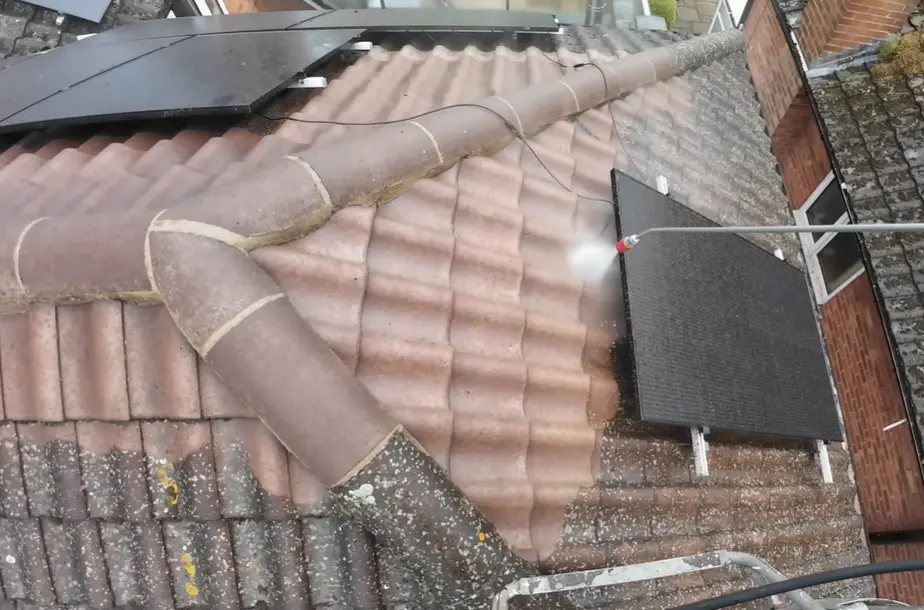
Asphalt shingles are covered in small mineral granules that protect the asphalt layer underneath from UV rays and weather. A pressure washer’s water stream, even at moderate settings, is strong enough to blast those granules loose.
Once enough granules are gone, the shingle underneath is exposed, ages faster, and starts to fail years ahead of schedule. High pressure can also force water sideways, up and under the shingle edges instead of down and off the roof the way rain does. That’s how a cleaning job turns into a leak that shows up months later, often nowhere near where the work happened.
Signs a roof has already lost granules to pressure or age:
- Bare, dark patches where the shingle color looks uneven.
- Granules collecting in gutters or at downspouts after rain.
- Shingle edges that look thinner or more brittle than the rest of the roof.
What Happens When You Pressure Wash a Tile Roof?
Tile holds up differently than asphalt, but it isn’t immune. Concrete and clay tile can crack under direct, close-range pressure, especially older or already-brittle tile. Harsh chemical treatments sometimes paired with high-pressure cleaning can strip tile’s color coating entirely, leaving it a washed-out, chalky white instead of its original color. That change doesn’t reverse. Once the coating is gone, it’s gone.
Walking a tile roof to pressure wash it adds a second risk. Foot traffic alone can crack tile that’s already brittle from age or sun exposure, regardless of the cleaning method.
What this can look like on an older tile roof:
- Faded or blotchy patches where the color coating has been stripped unevenly.
- Hairline cracks near the point where a technician would have stepped.
- Tile that looks lighter overall than it did before the last cleaning.
Why Do Roofing Manufacturers Prohibit Pressure Washing?
This isn’t just one contractor’s opinion. A pressure washing roof warranty conflict is written directly into the fine print. Major asphalt shingle manufacturers, including GAF, Owens Corning and CertainTeed, list pressure washing among the maintenance mistakes that can void a shingle warranty. The manufacturer warranty documentation ties coverage to following approved maintenance methods, and pressure washing isn’t one of them.
The Asphalt Roofing Manufacturers Association, the trade body whose technical guidelines shape how shingles are made and maintained, recommends low-pressure cleaning over power washing for treating algae and moss on asphalt shingle roofs. That guidance is where most manufacturer warranty language on this topic comes from.
What Is Soft Washing, and How Does It Actually Work?
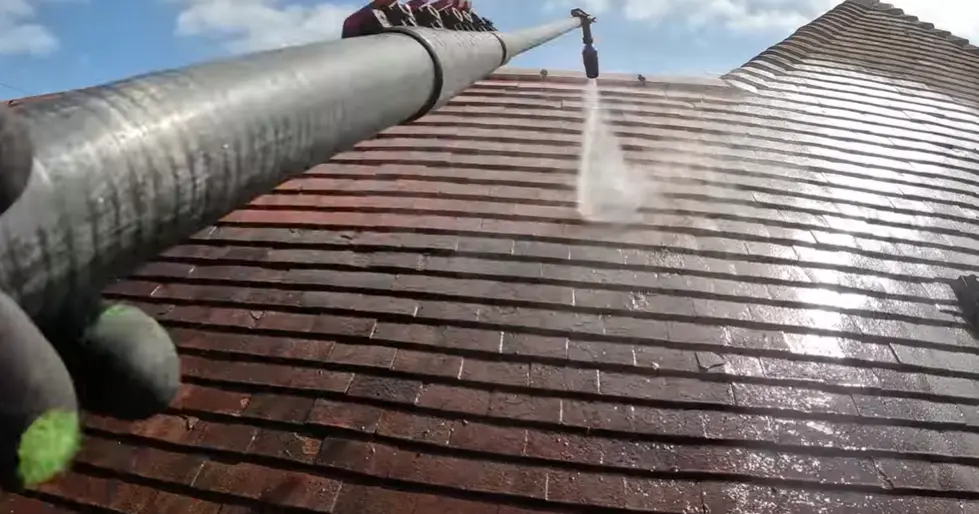
Soft washing uses a low-pressure sprayer, typically in the 250 to 300 psi range instead of the 2,000 or more psi a pressure washer puts out, paired with a diluted cleaning solution.
A mild sodium hypochlorite mix is the standard, applied at a low concentration rather than full-strength bleach.
The solution is applied, left to dwell for several minutes, and rinsed at low pressure. There’s no scrubbing, no close-range blasting and no walking the roof with a wand. The dwell time is what actually kills the algae, moss and mildew causing the discoloration. Pressure isn’t part of the equation at all, which is why soft washing doesn’t carry the same granule-loss or tile-cracking risk.
What Causes Roofs to Turn Black or Streaky in the First Place?
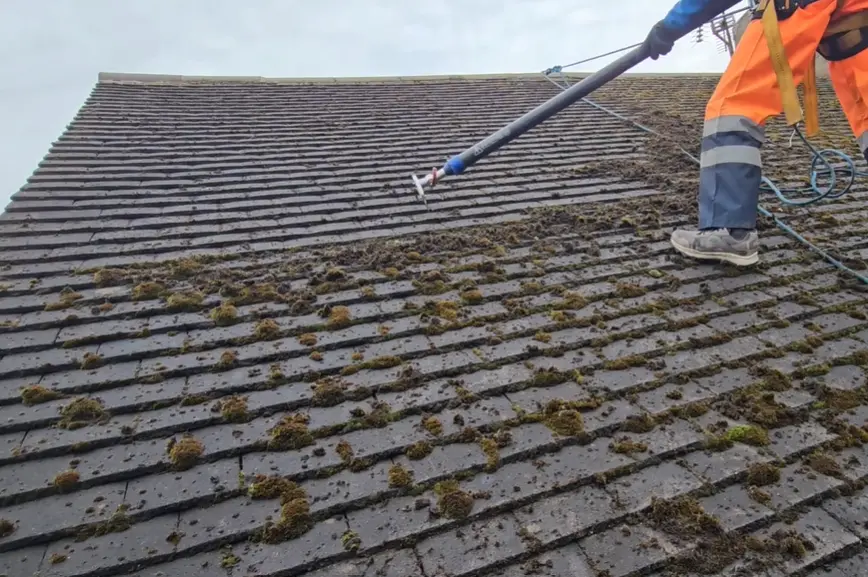
Those black streaks are usually a bacteria called Gloeocapsa Magma, not dirt or soot. It feeds on the limestone filler in shingles and spreads fastest on shaded, north-facing or moisture-prone sections of a roof. Moss is a separate problem. It roots into the shingle surface, and pulling it off by hand or by force takes granules with it, which is part of why moss removal specifically needs a gentle approach rather than scraping or blasting.
Does This Apply to Roofs in Palm Beach County, FL?
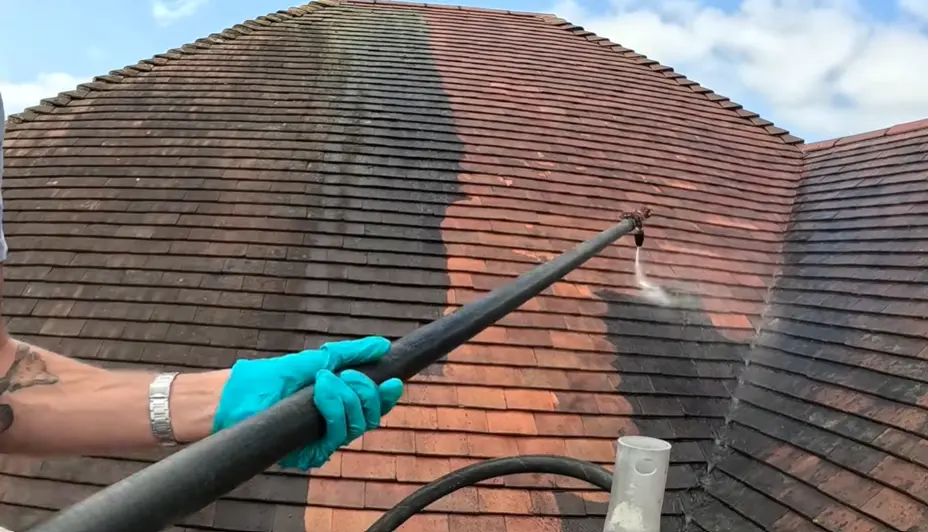
Yes, and the humidity here makes it more relevant, not less. Year-round moisture and shade from mature tree canopy keep algae active in this part of Florida in every season.
Roofs under oak canopy, or on older homes that have gone years between cleanings, tend to show the heaviest streaking.
We soft wash roofs across Palm Beach County, including Palm Beach Gardens, Jupiter, North Palm Beach and Juno Beach, where salt air from the Atlantic adds an extra layer of corrosion on top of the usual algae and moss. The cleaning method doesn’t change by city. What changes is how often a roof needs it.
What Should You Ask Before Hiring Someone to Clean Your Roof?
A few direct questions before you book tell you a lot about whether a company will treat your roof correctly.
- Do you pressure wash roofs, or do you soft wash them?
- What concentration of cleaning solution do you use, and how long does it dwell?
- Are you insured, and can you show proof before work starts?
- Will you walk the roof, or clean it from the ground or a ladder?
If the answer to the first question is pressure washing, that’s a warranty risk on the spot, not a judgment call.
Pressure Washing vs. Soft Washing for Roofs
Here’s how the two methods actually compare on a roof specifically, not on a driveway or patio where pressure washing is the right tool.
| Factor | Pressure washing | Soft washing |
|---|---|---|
| Water force | High, close range | Low, 250 to 300 psi |
| How it cleans | Physical force strips growth off | Cleaning solution kills growth, then rinses off |
| Granule loss risk | High | Low |
| Tile crack risk | Higher, especially older tile | Low |
| Manufacturer approved | No, most warranties exclude it | Yes, this is the recommended method |
| Right surface for it | Concrete, pavers, driveways | Roofs, stucco, screens, painted surfaces |
We Soft Wash Every Roof We Clean
No pressure washers touch tile or shingle roofs on our jobs. See our roof cleaning process or get a free quote.
Frequently Asked Questions
No. The risk comes from the water pressure itself, not the operator’s skill. Granule loss and tile cracking happen from close-range force regardless of who holds the wand.
Often, yes. GAF, Owens Corning and CertainTeed all list pressure washing among the maintenance issues that can void a shingle warranty, since it isn’t an approved cleaning method.
Soft washing. It uses low pressure and a diluted cleaning solution that kills algae and moss during a dwell period, then rinses off without blasting the surface.
Usually a bacteria called Gloeocapsa Magma, which feeds on limestone in the shingles. It is not dirt, and pressure alone will not fully solve it long term.
Yes, especially older or brittle tile. Direct pressure and foot traffic on the roof both add cracking risk, separate from any chemical used.
It depends on shade, tree cover and moisture. Roofs in shaded or humid areas typically need attention more often than roofs in full sun.
It depends on roof size, pitch and how much buildup there is. We give a firm written price after looking at the property rather than a flat rate.
Yes. We cover Palm Beach Gardens, Jupiter, North Palm Beach and Juno Beach in addition to West Palm Beach itself.
Need Your Roof Cleaned Safely?
We soft wash every roof, no pressure washers, no warranty risk. Written price before we start.
Get a Free Quote